
This article is for executives, CIOs, COOs and project leaders who are planning an ERP transformation — or are already in the middle of one — and are wondering why it's so hard.
ERP is not IT, it's Change
The Uncomfortable Finding
Gartner predicts that by 2027, more than 70% of all recently implemented ERP initiatives will fail to meet their original business objectives. (Gartner ERP Insights, approx. 2022/2023, confirmed through 2025 — Source)
Up to 25% will fail catastrophically.
And 75% of ERP strategies are not aligned with business strategy from the outset..
These are not abstract numbers. They represent wasted millions, lost years, frustrated employees — and a leadership team asking: why?
The answer is uncomfortable, but clear: It is not a technology problem. It is a leadership and change management problem.
In this article, I will show you at which two critical levels ERP projects typically fail — and what it concretely takes to be among the 30% who get it right.
Part 1: Why Do ERP Projects Fail Already in the Concept Phase?
ERP as a Strategic Capability — Not an IT Tool
The first and most consequential mistake happens before a single line of code is written.
In the Solution Design phase, many companies ask the wrong starting question. They ask:
„Which system best maps our current processes?"
Instead of:
"What digital capabilities do we need to remain competitive in 3 to 5 years?"
That is a fundamental difference — with far-reaching consequences.
An ERP system perfectly aligned with the status quo is already outdated at the moment of its implementation. Markets change. Business models evolve. Customer demands rise. What works today simply won't be enough tomorrow.
The most common mistakes in this phase:
- IT strategy not linked to business strategy: What are the concrete contributions to achieving company objectives? Where are the potentials? What digital capabilities must the company build? How does AI impact my business model?
- Too much focus on IT functionality, too little on strategic alignment and future readiness
- No clear Target Operating Model (TOM): How should the company function after the transformation?
Conclusion of this phase: ERP is not an IT tool. It is a strategic lever for business transformation and development. Those who don't understand this from the outset build on the wrong foundation — and pay dearly for it later.
Part 2: Why Does Implementation Fail — Even When the Objectives Are Right?
The Iceberg Model of Change
Assume the strategic objectives are clearly defined. The right system has been selected. The business case is solid. The project plan is in place.
And yet the project goes off the rails. Deadlines are missed. Budgets are exceeded. The new system is barely used after go-live. The expected ROI never materialises.
How is that possible?
Prosci — one of the world's leading research institutes for change management, with over 25 years of experience and studies from thousands of transformation projects worldwide — has provided the empirically proven answer:
The biggest obstacles in ERP implementations are not at the technical level. They lie below the surface.
Imagine an iceberg. What you see — systems, processes, technology, project plans — is the visible part. What actually causes projects to fail is what you don't see: lack of willingness to change, active or passive resistance at all hierarchical levels, insufficient capability and motivation of employees, inadequate executive sponsorship.
Prosci calls this the "People Side of Change" — and this is precisely where most ERP projects lose the decisive battle.
The Data Doesn't Lie: Every Step Counts
And here is the critical point: change management doesn't have to be perfect to work.
Prosci's research data shows a clear pattern — and an important message I cannot withhold from you:
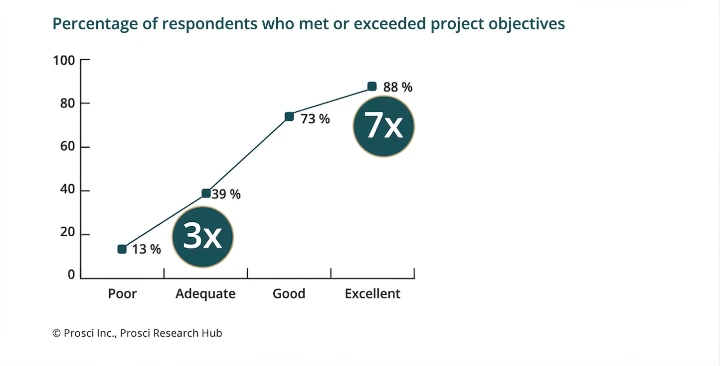
Even projects with poor change management achieve their goals in 13% of cases. Not impressive — but as soon as minimal, adequate change management is applied, that rate immediately rises to 39%. That is a tripling of the success rate — from that one first step alone.
With good change management, we reach 73%. With excellent change management: 88% — that is a 7 times higher probability of success compared to projects that forgo change management entirely.
What does this mean for you concretely?
First: no company needs to start at "excellent". A modest start is better than no start at all. Those who begin today to consistently look at the human side of transformation set a positive spiral in motion — and improve their chances of success with each iteration.
Second: the biggest leap does not happen between "good" and "excellent". It happens between "nothing at all" and "adequate". The first step carries the highest leverage.
Bottom line? The question is no longer whether you can afford change management. The question is whether you can afford to go without it.
The PROSCI Approach: An Integral Change Management Framework
Change management is not a "nice to have". It is the decisive success factor — and that is not an opinion, it is backed by decades of research..
The Prosci ADKAR Model describes precisely what every individual employee must go through for change to truly succeed:
- A — Awareness: Understanding why the change is necessary
- D — Desire: The desire to support the change
- K — Knowledge: The knowledge of how the new way of working functions
- A — Ability: The ability to apply the new approach in daily practice
- R — Reinforcement: The anchoring through consistency, measurement and recognition
Most ERP projects only address K (training) — and then wonder why the system isn't being used. Because without Awareness, Desire and Ability, even the best training falls on deaf ears.
In parallel, John P. Kotter's 8-Step Model describes the organisational dimension: create urgency, build a guiding coalition, formulate a clear vision, communicate it, remove obstacles, generate short-term wins, sustain the effort, and anchor the change in the corporate culture.
And Fredmund Malik reminds us of a simple truth: managers are the true change agents. If middle management is not convinced, it will offer passive resistance — silent, invisible, but extremely effective.
A critical distinction is important here: sponsors provide direction, legitimacy and backing — top-down. Change Agents, on the other hand, act from within: as multipliers at team and department level, close to those affected, credible because they are themselves part of the change. Both roles are indispensable — and they complement each other.
Change management secures project success by:
- Identifying resistance early and addressing it — not fighting it
- Reaching the right stakeholders at the right time with the right messages
- Empowering leaders to actively embody their role as change role models
- ucturally accompanying the transition to autonomy — until the organisation is truly working independently
Conclusion: ERP is Business Transformation — and Must Be Treated as Such
Let me be direct:
An ERP project managed primarily as an IT project has a high probability of failing. This is what Gartner, Prosci — and three decades of my own experience transforming companies across a wide range of industries — show.
What is needed instead:
- Strategic alignment from the outset — ERP as an enabler of business objectives and digital future-readiness, not as a reflection of current processes
- A clear Target Operating Model — What does the company look like after the transformation? What should be different, better, faster?
- Active and visible executive sponsorship — Not merely nominal, but consistently present, engaged and exemplary
- An integrated change management approach — Using proven methodologies like the PROSCI framework, which prepares and accompanies the entire organisation through the change
- Dedicated resources for change management — No "20% of someone's time" approach. Change management is a full-time task.
ERP is not a technology decision. It is a strategic decision about the future of your company.
And successful business transformation does not begin with platforms. It begins with leadership, strategic clarity — and the courage to put people at the centre.
What Is Your Experience?
Have you experienced an ERP project that failed on the human side? Or one that succeeded despite all resistance — because the change management was right?
I look forward to the exchange in the comments.
Olivier Gemoets is the founder of INNOCARUS Ltd. For three decades, he has guided companies through complex transformations — from strategy through to operational anchoring. Areas of focus: Digital Transformation, ERP/CRM projects, Change Management & Interim Leadership.